
The photobooth is a cultural phenomenon that has greatly impacted photography as a medium. From the beginning, photography was very staged. It was very difficult for people to have truly authentic moments with the camera, as there was always a photographer behind it. The photobooth introduced an extremely intimate component that no other photographic contraption offered. “Before the photobooth first appeared, in the 1920s, most portraits were made in studios. The new, inexpensive process made photography accessible to everyone” (“Four for a Quarter”). As a result, it was massively popularized throughout the world. “Everyone loved sitting in the booth, making faces, kissing, squeezing in friends” (“History of the Photobooth”). However, complaints started coming in as early as the mid-Fifties regarding people’s behavior within the photobooth. Many people were taking advantage of the fact that the photobooth offered a much more private setting for those being photographed. As a result, many people took that as a cue to start acting inappropriately with partners or even stripping down their clothes, so they were nude. Comically, many stores removed the curtain in order to inhibit this public indecency.
The photobooth is so special because of how quickly it rose to fame. In 1921, Josepho Anatol, was in China. He constructed a rough idea as to how he could execute his invention. In order to get his creation off the ground, he came to America in pursuit after investors. With the help of friends and relatives in New York City, he was able to raise $11,000. “To understand how much money $11,000 was then, the average cost of a reasonably sized house in 1925 was $2,000” (“History of the Photobooth”). Thus, we can definitely assert that he had the resources to carry out his plan, and that he did! He was able to find the appropriate machinists and engineers to help him build the photobooth. By September of 1925, he opened up his Photomaton Studio. “Crowds, as many as 7,500 people a day, would line up to have their photos taken for 25 cents for a strip of eight” (“History of the Photobooth”). Josepho Anatol had achieved the American Dream within a mere span of four years.
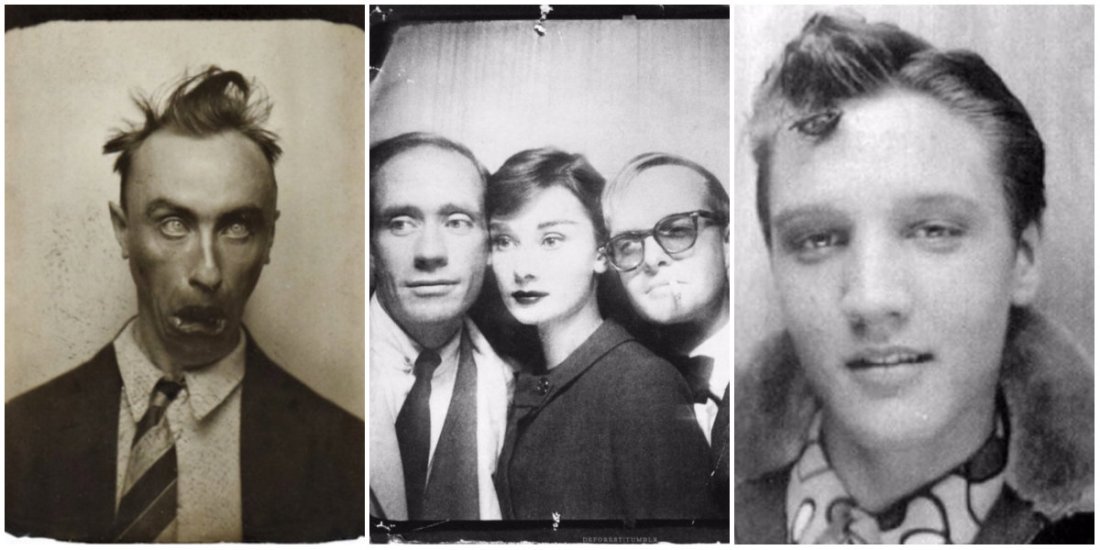
The photobooth was characteristically unique for its qualities. Firstly, the fun part of a photobooth was squeezing everyone in to fit within frame. To many this would be seen as a limitation; however, to many, it’s what made it fun. Another key point is that the photobooth produced black and white images. To many, included the famous Andy Warhol, this was seen as an advantage. “When Warhol looked at the black-and-white photostrip, he saw it fully expanded” (“History of the Photobooth”). Hence, Warhol, along with many other artists, utilized the photobooth to depict famous people in a much more relaxed setting. This can be depicted below in the three images provided. All of these people have an insane amount of fame attached to their name; however, the photobooth has a normalizing quality to it. The photobooth simply captured people in their most genuine, human state, which is what makes it so incredible.
https://www.vintag.es/2017/01/before-cell-phones-and-selfie-sticks.html
 Lindsey's Blog